
Circular saw vs table saw vs miter saw: for most beginners, a circular saw is the best first buy. It is usually the least expensive of the three, fits on a shelf, cuts both boards and full plywood sheets, and with a simple straightedge guide makes accurate cuts. Add a miter saw for fast, repeatable crosscuts, and a table saw later for precise rip cuts.
That is the short answer. The right choice also depends on your space and the projects you want to build, so this guide walks through what each saw does well and where it struggles. For the full starter kit, see our guide to essential woodworking tools for beginners.
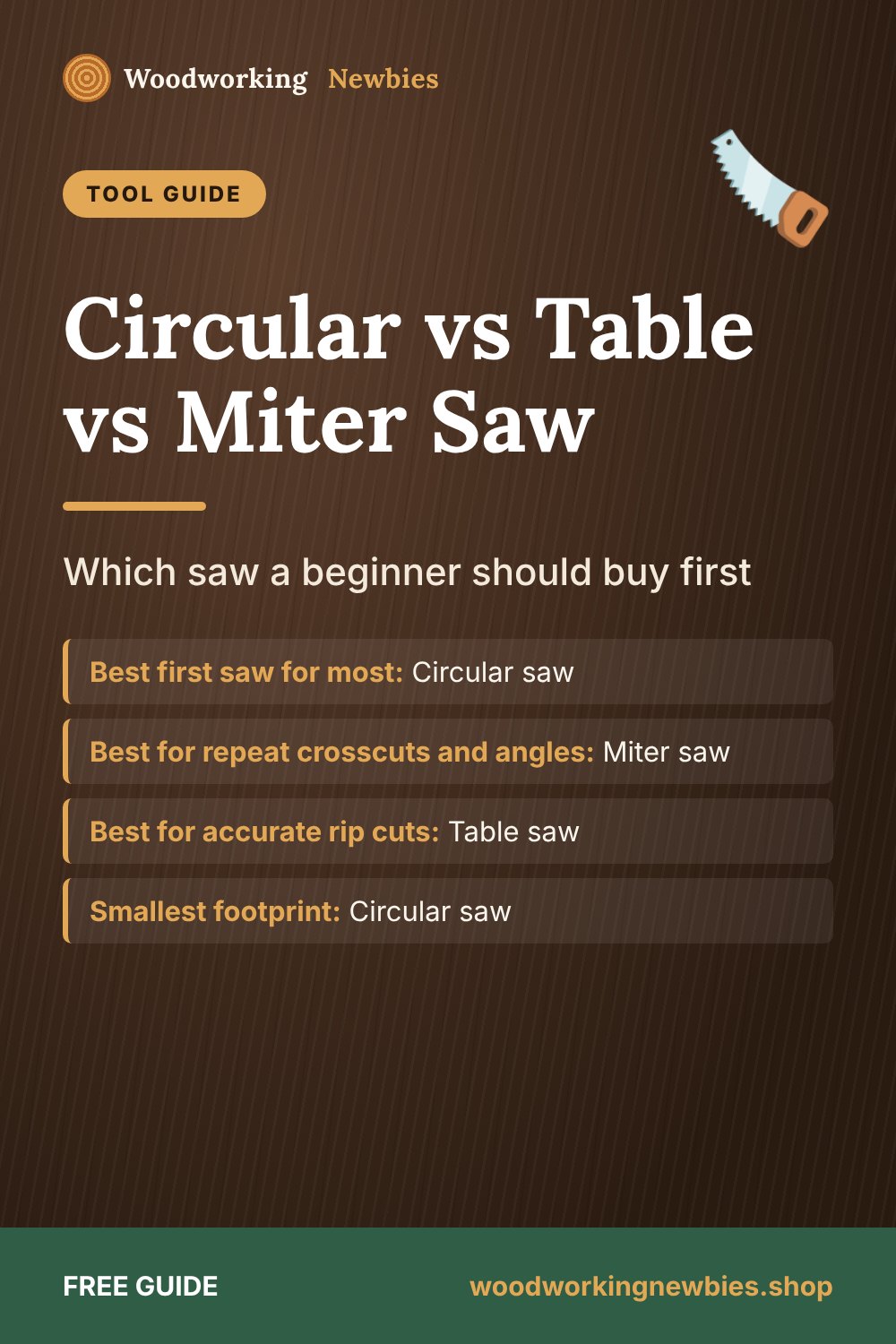
At a glance
- Best first saw for most
- Circular saw
- Best for repeat crosscuts and angles
- Miter saw
- Best for accurate rip cuts
- Table saw
- Smallest footprint
- Circular saw
- Easiest to learn
- Miter saw
Beginner shortcut
Whichever saw you pick, choose projects that suit it. Many TedsWoodworking plans come with cut lists, so you can see exactly which cuts a project needs before you start.
The three saws in one sentence each
- Circular saw: a handheld saw you move through the wood. Flexible, portable, and the only one of the three that easily handles a full 4x8 ft sheet of plywood.
- Miter saw: a saw on a pivoting arm that you pull down onto a board held against a fence. Fast, clean crosscuts and angle cuts on boards.
- Table saw: a blade sticking up through a table, and you push the wood past it along a fence. The most accurate way to rip boards to width and cut parts to identical sizes.
Side-by-side comparison
| Job or factor | Circular saw | Miter saw | Table saw |
|---|---|---|---|
| Crosscuts on boards | Good with a speed square | Excellent | Good with a miter gauge or sled |
| Rip cuts (along the grain) | Good with a guide | Not possible | Excellent |
| Full plywood sheets | Excellent | Not possible | Hard without help and support |
| Angles and bevels | Possible, less precise | Excellent | Good |
| Repeat parts, same length | Slow | Excellent with a stop block | Excellent |
| Joinery (dadoes, grooves) | Limited | Limited | Good |
| Space needed | A shelf | A bench or stand | A dedicated spot plus room around it |
| Learning curve | Moderate | Easy | Steepest |
The circular saw: the do-almost-anything first saw
A circular saw can do a rough version of almost every cut. Clamp a straight board or a factory plywood edge to your workpiece as a guide, and you get straight rips and crosscuts on anything from a 2x4 to a full sheet of plywood. Our guide on how to cut straight with a circular saw shows the trick step by step.
Good for: workbenches, shelves, garden beds, plywood storage, and most 2x4 projects.
Weak spots: it is slower to set up for each cut, and small parts are hard to hold safely.
Safety notes: clamp the work, support it so the cut does not close up and pinch the blade (a common cause of kickback), set the blade depth only slightly deeper than the wood, and let the blade stop before you lift the saw.
The miter saw: fast, accurate crosscuts
If your projects are mostly boards cut to length, a miter saw is the quickest and easiest saw to use well. Swing the table for miters, tilt the head for bevels, and clamp a stop block to the fence so every part comes out the same length. Picture frames, trim, planters, and many 2x4 builds go together much faster with one.
Good for: frames, trim, outdoor furniture from 2x lumber, and anything with lots of identical parts.
Weak spots: it cannot rip boards or cut sheet goods, and a basic non-sliding saw only crosscuts fairly narrow boards. Check the crosscut capacity before you buy if you work with wide boards.
Safety notes: hold the board firmly against the fence, keep your hands well clear of the blade path, never cut tiny pieces you cannot hold safely, and let the blade stop completely before you raise it.
Plans for any saw
Pick projects that match the saw you own
TedsWoodworking includes 16,000+ plans, and according to the sales page most plans need only a saw, a drill, clamps and a sander.
- Cut lists show every crosscut and rip in advance
- Materials lists so you buy the right boards
- Step-by-step diagrams for beginners
- $67 one time, lifetime access, no monthly fees
Read our honest TedsWoodworking review before you decide.
The table saw: precision, with the most to learn
A table saw is the heart of many furniture shops. Set the fence once, and every rip cut comes out the same width. With a crosscut sled, it also makes very square crosscuts, and it can cut grooves, dadoes and rabbets for stronger joints.
Good for: furniture, cabinets, boxes, and any project with many parts that must match.
Weak spots: it takes up the most floor space, needs room in front of and behind the blade, and full plywood sheets are awkward to handle alone. Many people break sheets down with a circular saw first anyway.
Safety notes: a table saw demands respect. Kickback can throw a board hard, and hands can get too close to the blade. Learn the basics in our table saw safety rules for beginners before your first cut, then build skills with these table saw projects for beginners.
Which should a beginner buy first?
Match the saw to what you plan to build in the next six months:
| If you mostly want to build... | Buy first | Add next |
|---|---|---|
| Workbenches, shelves, plywood storage | Circular saw | Miter saw |
| 2x4 outdoor furniture and garden projects | Circular saw or miter saw | The other one |
| Picture frames, trim, small decor | Miter saw | Circular saw |
| Indoor furniture, boxes, cabinets | Circular saw | Table saw |
| You live in an apartment | Circular saw (used outdoors) or hand saws | Decide later |
Why not start with the table saw?
You can, and some people do. But a table saw is the hardest of the three to use safely, needs the most space, and still struggles with full sheets. Starting with a circular saw lets you build real projects right away, including a workbench and outfeed support that make a table saw easier to use later.
Do I eventually need all three?
Not necessarily. Plenty of hobbyists build for years with a circular saw and a miter saw. Buy the next saw when a specific project keeps fighting you, not before.
Space and noise: the questions people forget
- Storage: a circular saw lives on a shelf. A miter saw needs a bench or folding stand. A table saw needs a permanent spot or a mobile base.
- Working room: to rip an 8 ft board on a table saw, you need about 8 ft of clear space in front of the blade and behind it. A miter saw needs room on both sides for long boards.
- Noise: all three are loud. Wear hearing protection with every saw. If noise is a problem, hand saws are the quiet option.
If you are planning a garage shop, our one-car garage shop layout shows where each saw fits best.
Got your first saw? Pick your first project
Find a plan that fits the tools you own inside TedsWoodworking, with cut lists and diagrams for every step. One payment and a 60-day refund window.
One-time payment · Lifetime access · 60-day money-back guarantee
Save this for later
Pin this guide to your woodworking board on Pinterest so it is ready when you head to the shop.
FAQ
Can a circular saw replace a table saw?
For many beginner projects, yes. With a straightedge guide it makes accurate rips and crosscuts. It is slower for many identical parts and not as good for joinery cuts.
Can a miter saw cut plywood?
Only narrow strips. It cannot rip boards along their length or cut a full sheet. Use a circular saw for plywood.
Is a table saw more dangerous than a circular saw?
Both can cause serious injury. A table saw has more ways to go wrong for a beginner, especially kickback, so learn the safety rules and use the guard, riving knife and push sticks every time.


