
The essential woodworking tools for beginners are a tape measure, a square, a saw (circular saw or hand saw), a cordless drill, a few clamps, a sander and safety gear. With those seven things you can build shelves, boxes, benches, planters, a workbench and most of the projects on this site. Big machines like a table saw or a router are wonderful, but they can wait until you know you love the hobby.
This guide groups the basic tools to start woodworking by job, tells you what to look for in each, and shows you which upgrades are worth it later. It's part of our woodworking for beginners series.
The golden rule: buy tools for your next project
Don't buy a full shop on day one. Pick your first project, look at its tool list, and buy only what that project needs. A good plan lists the tools up front, so you never buy something that sits in a box.
Beginner shortcut
Every plan in the TedsWoodworking library lists the materials you need, and the sales page says most plans need only a saw, a drill, clamps and a sander, which is exactly the starter kit below.
1. Measuring and marking tools
Accurate measuring is the most important skill in woodworking, and these tools are inexpensive.
- Tape measure (25 ft / 7.5 m). Look for a wide, stiff blade and clear 1/16-inch markings.
- Speed square. A triangle-shaped square that marks 90° and 45° lines quickly and doubles as a saw guide.
- Combination square (12 in). Marks lines, checks corners and measures depths. Probably the tool you'll reach for most.
- Pencils and a marking knife. A sharp, thin line makes accurate cuts possible.
2. Cutting tools
| Tool | Best for | Beginner tip |
|---|---|---|
| Circular saw | Cutting boards to length and breaking down plywood | Clamp a straight board as a guide for perfectly straight cuts |
| Hand saw (Japanese pull saw) | Quiet, precise cuts in small parts | Great for apartments and small spaces |
| Jigsaw | Curves and cut-outs | Use a fine-tooth blade for cleaner edges |
| Miter saw (later) | Fast, accurate crosscuts and angles | A great second power saw if you build a lot with 2x4s |
If you're torn between a circular saw and a table saw, start with the circular saw. It's cheaper, portable, needs no dedicated space, and with a guide it cuts as straight as you need for beginner projects.
3. Drilling and fastening
- Cordless drill/driver. The workhorse of beginner woodworking. Get one with a clutch so you don't strip screws.
- Drill bits and driver bits. A basic set of twist bits, a countersink bit, and Phillips and square (Robertson) driver bits.
- Pocket hole jig. Lets you join boards with hidden angled screws. It's the fastest way for a beginner to make strong furniture joints. Learn more in our guide to wood joints for beginners.
- Impact driver (optional). Drives long screws into 2x4s with less effort. Handy for outdoor and workshop builds.
4. Clamps
Every woodworker says the same thing: you can never have too many clamps. They hold parts while glue dries, keep boards still while you cut, and act as an extra pair of hands.
- Start with four bar clamps (12 to 24 inches) for most glue-ups.
- Add two spring clamps for quick, light holding.
- Later, add longer clamps (36 inches or more) for tabletops and cabinets.
5. Sanding and finishing
- Random orbital sander (5 in). Smooths surfaces quickly without swirl marks. Buy hook-and-loop discs in 80, 120, 180 and 220 grit.
- Sanding block. For edges and small parts.
- Brushes and lint-free rags for stain and finish.
6. Safety gear (buy this first)
- Safety glasses that you'll actually wear
- Hearing protection (earplugs or earmuffs)
- A dust mask or respirator rated for fine dust
- Push sticks if you ever use a table saw
- A small fire extinguisher and first aid kit in the shop
Put your tools to work
You've got the tools. Now you need the plans.
TedsWoodworking gives you 16,000+ plans with exact cut lists for a one-time $67, so each new tool gets used on a real project.
- Plans sorted by category and difficulty
- Materials lists so you know what to buy
- Bonus woodworking videos for new techniques
- 60-day money-back guarantee through ClickBank
Read our honest TedsWoodworking review first if you want the pros and cons.
Tools that can wait
These are excellent tools, but most beginners don't need them for their first few months:
- Table saw. The heart of many shops, but it's expensive, needs space and has a learning curve. Buy one when you find yourself ripping many boards to width.
- Router. For decorative edges, grooves and joinery. Wonderful, but not essential for simple builds.
- Planer and jointer. Needed to mill rough lumber. Beginners can buy boards already surfaced on all four sides ("S4S").
- Bandsaw. Great for curves and resawing, but a jigsaw covers most beginner curves.
A sample starter shopping list by project
| First project | Tools you need |
|---|---|
| Simple box or crate | Tape, square, saw, drill, sander |
| 2x4 workbench | Tape, square, circular saw, drill, clamps |
| Garage storage shelves | Tape, square, circular saw, drill, level |
| Cutting board gift | Saw, clamps, sander, glue |
How to save money on tools
- Stick to one battery platform so every cordless tool shares the same batteries.
- Buy kits (drill plus impact driver) when they're on sale.
- Look for good used hand tools at garage sales: squares, clamps and hand saws last for decades.
- Rent or borrow big tools for one-off jobs.
- Let the lumber store cut plywood to rough size for you.
Build something with your new tools this weekend
Pick a beginner plan that matches the tools you already own inside TedsWoodworking. It's a one-time payment with lifetime access and a 60-day refund.
One-time payment · Lifetime access · 60-day money-back guarantee
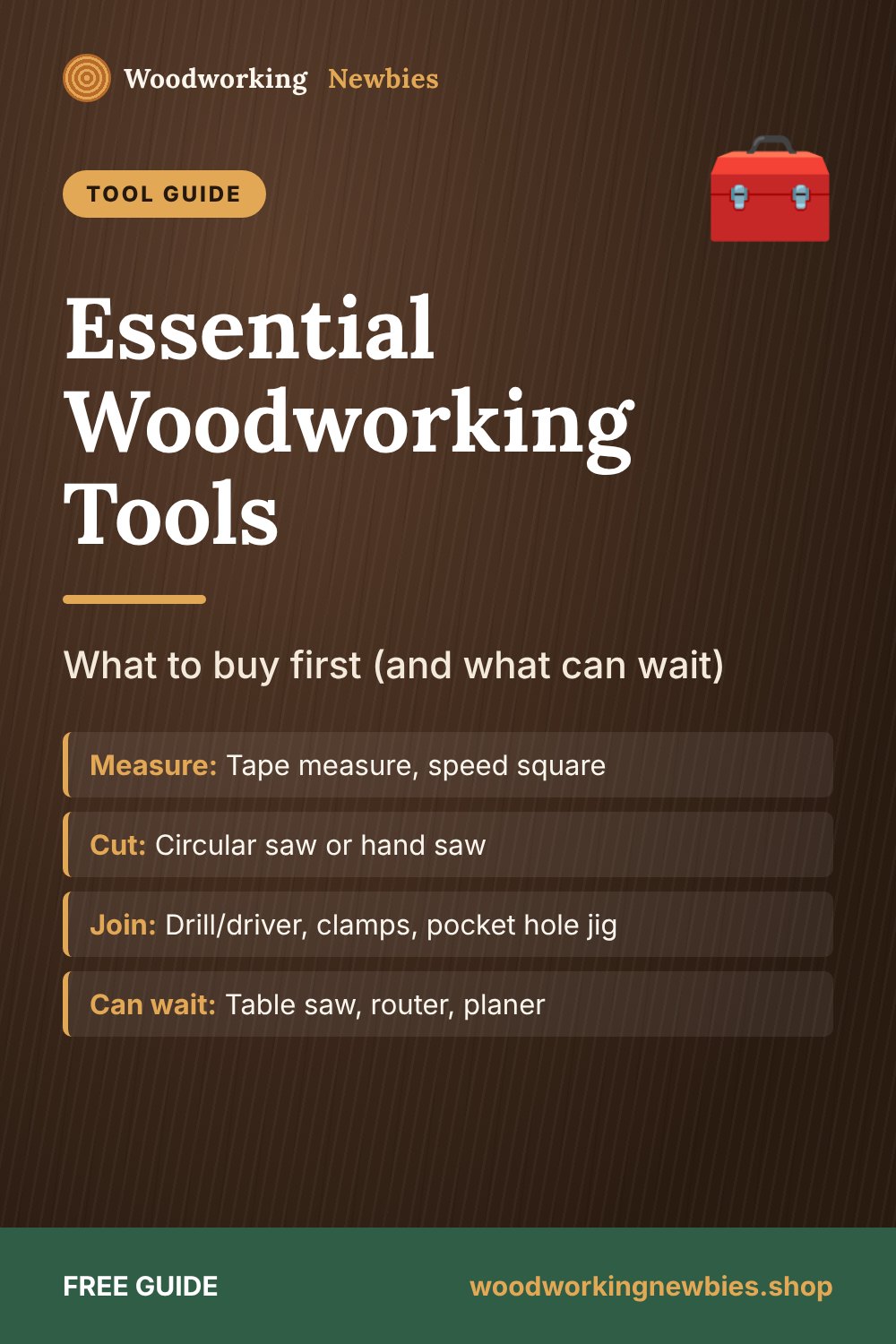
Save this for later
Pin this guide to your woodworking board on Pinterest so it is ready when you head to the shop.
FAQ
What are the five basic tools for woodworking?
A tape measure, a square, a saw, a drill/driver and clamps. Add a sander and safety gear and you can build most beginner projects.
Should a beginner buy a table saw first?
Usually not. A circular saw with a straight-edge guide is cheaper, smaller and handles beginner projects well. Upgrade once you're ripping lots of boards.
Corded or cordless tools?
Cordless for drills and drivers, because the freedom is worth it. Corded is fine for sanders and saws you use in one spot.
What is a pocket hole jig used for?
It drills angled holes so you can join boards with hidden screws. It's one of the easiest ways for a beginner to build strong furniture.


