
Hand tool woodworking for beginners starts with eight tools: a two-sided pull saw, a back saw, a jack plane, a block plane, a set of four chisels, a combination square, a marking gauge and a sharpening kit. Add a sturdy bench, two clamps and a mallet, and you can cut every basic furniture joint quietly, with little dust and no power cords.
Hand tools are a great fit if you have limited space, noise-sensitive neighbors, or you simply enjoy slower, hands-on work. If you are brand new to the hobby, our guide on how to start woodworking with no experience covers the big picture first.
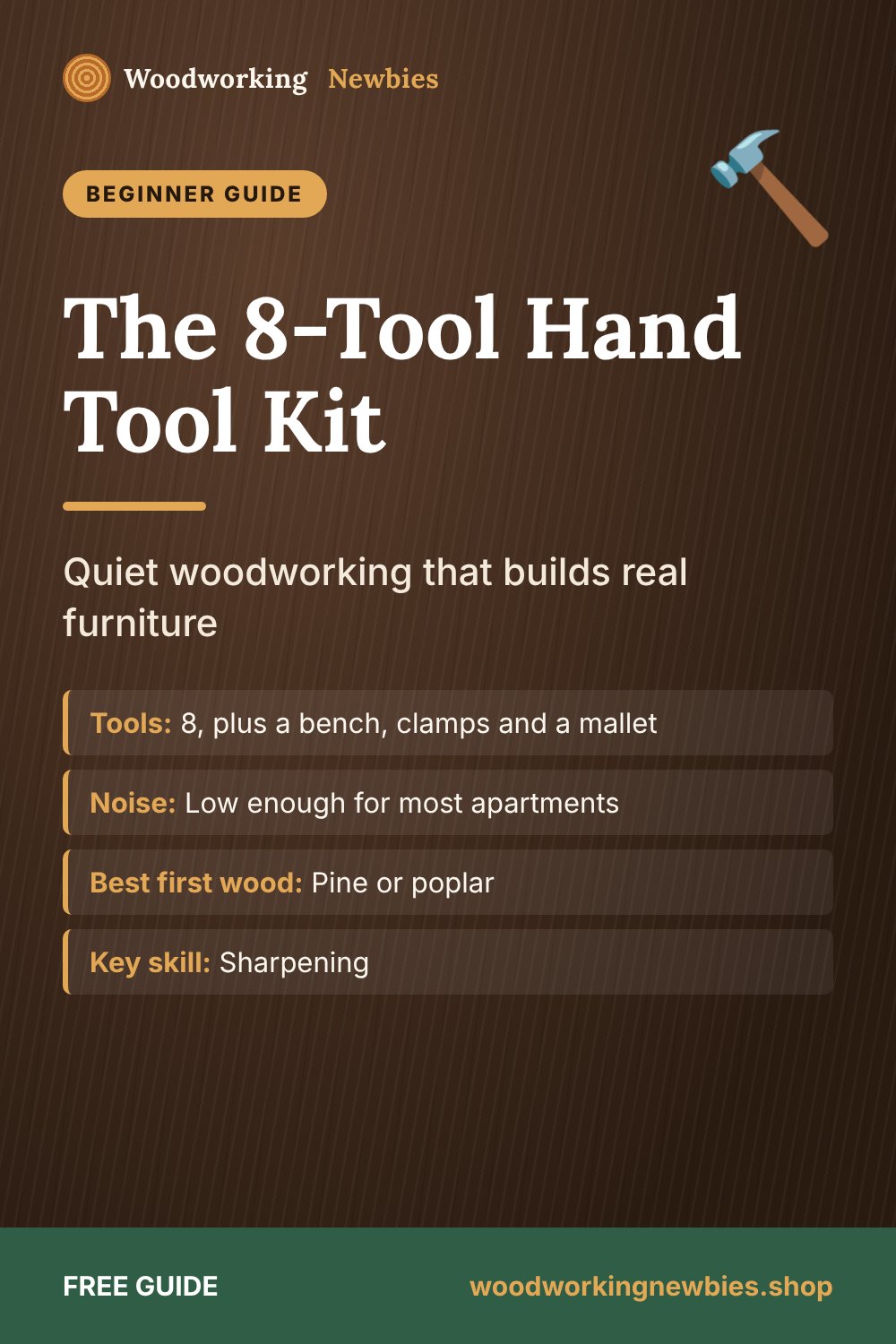
At a glance
- Tools
- 8, plus a bench, clamps and a mallet
- Noise
- Low enough for most apartments
- Best first wood
- Pine or poplar
- Key skill
- Sharpening
- First projects
- Bench hook, shooting board, small box
Beginner shortcut
Hand tools reward a clear plan. The TedsWoodworking library includes cut lists and diagrams for small boxes, stools and tables, so you know every joint before you start sawing.
The 8-tool hand tool kit at a glance
| Tool | What it does | Buying tip |
|---|---|---|
| 1. Pull saw (two-sided) | Rips and crosscuts boards | One edge for ripping, one for crosscutting |
| 2. Back saw | Fine cuts for joints | A stiff spine keeps the cut straight |
| 3. Jack plane | Flattens and straightens boards | Bench plane about 14 in long (No. 5 size) |
| 4. Block plane | Trims end grain and chamfers edges | A low-angle model handles end grain well |
| 5. Bench chisels (4) | Cleans joints, chops mortises | About 1/4, 1/2, 3/4 and 1 in widths |
| 6. Combination square | Marks square lines and checks angles | Check it is truly square before you rely on it |
| 7. Marking gauge | Scribes lines parallel to an edge | Wheel-type gauges are easy for beginners |
| 8. Sharpening kit | Keeps chisels and plane blades sharp | Two-sided stone or sandpaper on a flat surface, plus a honing guide |
The cutting tools: saws
1. Two-sided pull saw
Japanese-style pull saws cut on the pull stroke, so the thin blade stays straight and tracks a line easily. A two-sided version has rip teeth on one edge (for cutting along the grain) and crosscut teeth on the other. For a beginner, this one saw replaces two traditional Western panel saws.
2. Back saw
A back saw has a stiff metal strip along the top of the blade, so it makes straight, shallow cuts for tenons, dovetails and half-laps. You can choose a Western back saw or a Japanese pull saw with a stiffened back. Both work. Start the cut on the far corner, keep the pressure light, and let the saw do the work.
The shaping tools: planes and chisels
3. Jack plane
The jack plane is the workhorse. It flattens a cupped board, straightens an edge for gluing, and removes saw marks. A bench plane about 14 in long (often called a No. 5) is long enough to straighten edges but light enough to use all day. A good used plane cleaned up and sharpened often works as well as a new one.
4. Block plane
This small plane fits in one hand. Use it to trim end grain, chamfer sharp edges and fine-tune joints so they fit. A low-angle block plane cuts end grain more cleanly than a standard one.
5. Bench chisels
Four widths cover nearly every joint: about 1/4 in, 1/2 in, 3/4 in and 1 in (6, 12, 19 and 25 mm). Use them to pare a tenon to fit, clean the bottom of a dado, and chop out dovetail waste. Always keep both hands behind the cutting edge and cut away from your body.
Plans for hand tools
Build furniture one joint at a time
TedsWoodworking offers 16,000+ plans with cut lists and step-by-step diagrams, including small projects that suit a quiet, hand tool workshop.
- Boxes, stools, shelves and small tables
- Cut lists and materials lists included
- Beginner guides and 150 woodworking videos as bonuses
- One-time $67 with a 60-day money-back guarantee
Want the full picture first? Read our honest TedsWoodworking review.
The layout tools: square and gauge
6. Combination square
You will use the combination square on almost every cut: marking lines across a board, checking that edges are square, and setting depths. Check yours by drawing a line, flipping the square over, and drawing again. If the two lines do not match, the square is out. Our guide to measuring and marking wood accurately goes deeper.
7. Marking gauge
A marking gauge scribes a fine line a set distance from an edge, such as the thickness of a tenon or the depth of a dovetail. A knife line is more accurate than a pencil line, and a saw or chisel settles right into it.
The tool that makes the others work: sharpening
8. Sharpening kit
Dull tools are the number one reason beginners give up on hand tools. A sharp chisel slices pine cleanly. A dull one crushes and tears it, and needs more force, which makes slips more likely. You need:
- A medium and a fine sharpening surface (a two-sided waterstone or diamond plate, or wet-and-dry sandpaper stuck to glass or a granite tile)
- A honing guide to hold the blade at a steady angle
- A strop or fine stone to remove the burr
Most chisels and plane blades come ground at about 25°. Many woodworkers hone a small secondary bevel a few degrees steeper, around 30°, because it is quick to refresh. Hone little and often, and you will rarely need a long sharpening session.
What you also need: bench, clamps and a mallet
- A solid bench: hand planing pushes hard, so the bench must not slide or wobble. Our 2x4 workbench plans work well for hand tools.
- Two or more clamps: to hold boards while you saw and chop.
- A mallet: wooden or rubber, for chopping with chisels. You can make one as an early project.
Hand tool woodworking for beginners: your first five projects
- Bench hook: a board with a cleat on each side that hooks over the bench edge and holds work for crosscutting.
- Shooting board: a jig for trimming end grain square with your plane.
- Mallet: practice sawing and chiseling a simple handle joint.
- Small box: teaches rabbets or simple dovetails and accurate layout.
- Step stool: your first real furniture, with through-tenons or dadoes.
The joints you will learn are covered in our guide to wood joints for beginners, and our comparison of pocket holes vs mortise and tenon shows why the hand-cut version is worth learning.
Tips that save beginners months of frustration
- Start with soft, straight-grained wood. Pine and poplar saw and plane easily.
- Buy fewer, better tools. Eight good tools beat a big cheap set that will not hold an edge.
- Practice on scrap. Ten practice cuts on an offcut are better than one rushed cut on your project.
- Short on space? Hand tools are quiet enough for most apartments.
Find a hand tool project for this weekend
Browse thousands of plans inside TedsWoodworking and pick a small build that fits your kit. Lifetime access, no monthly fees, 60-day refund.
One-time payment · Lifetime access · 60-day money-back guarantee
Save this for later
Pin this guide to your woodworking board on Pinterest so it is ready when you head to the shop.
FAQ
Can you build furniture with only hand tools?
Yes. Furniture was made by hand for centuries. It is slower than using power tools, but with a sharp kit you can build tables, stools, boxes and shelves.
What is the most important hand tool for a beginner?
The sharpening kit. Every saw, plane and chisel depends on a sharp edge. After that, a good saw and a jack plane do the most work.
Should I buy new or used hand tools?
Both work. Used planes and chisels can be excellent once cleaned and sharpened. Check for cracks, deep pitting and missing parts before you buy.


