
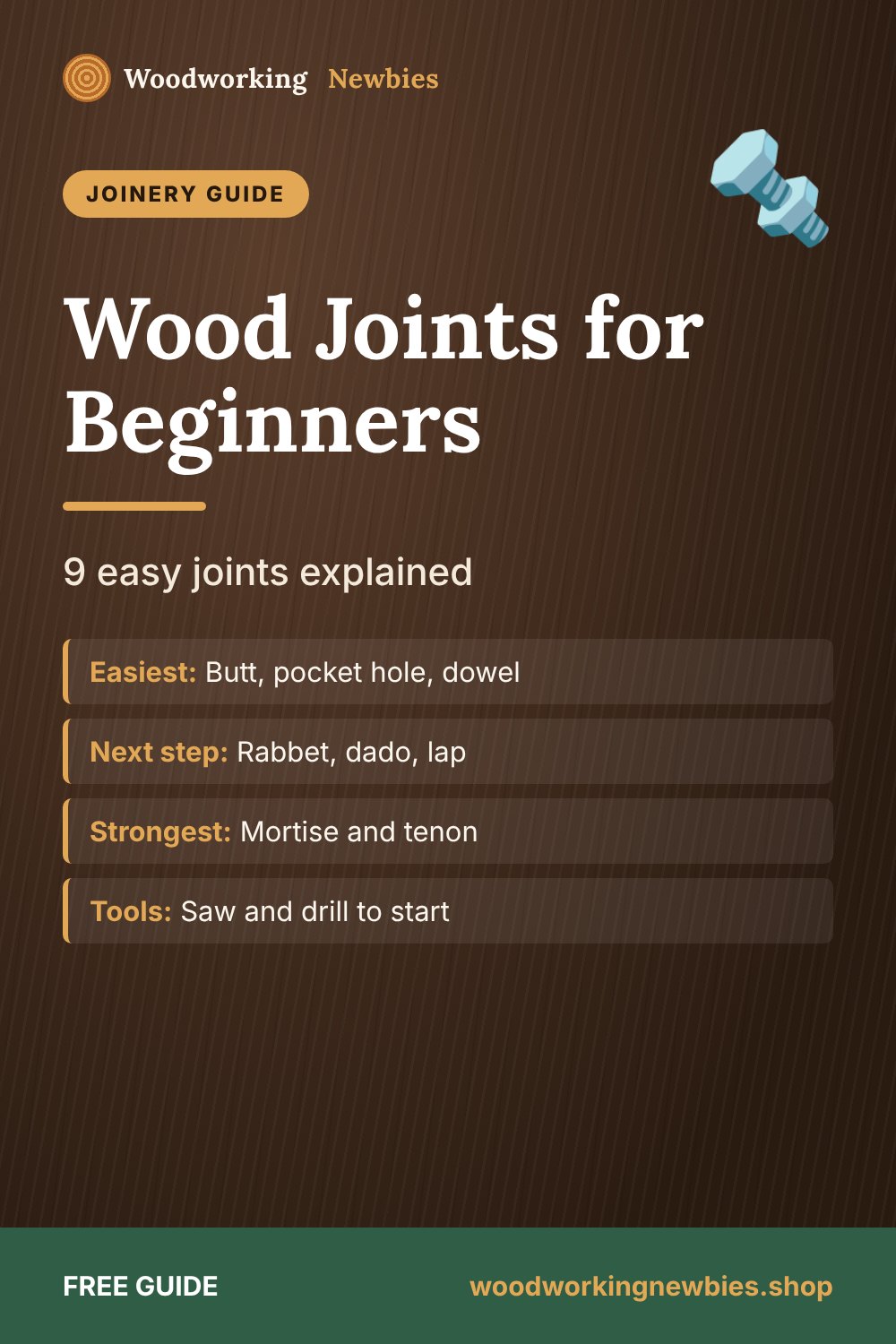
The easiest wood joints for beginners are the butt joint, the pocket hole joint and the dowel joint. You can make all three with a saw and a drill. Once you're comfortable, rabbet, dado and lap joints add strength and a cleaner look, and miter, box and mortise and tenon joints are great skills to work toward. Below, each joint is explained in plain English, with the tools it needs, how strong it is and when to use it.
If you're just getting started, our woodworking for beginners roadmap shows which projects to build first, and our beginner tool guide covers everything mentioned here.
Wood joints at a glance
| Joint | Difficulty | Strength | Main tools | Best for |
|---|---|---|---|---|
| Butt joint | Very easy | Low (strong with screws) | Saw, drill | Boxes, frames, shop projects |
| Pocket hole | Very easy | Good | Pocket hole jig, drill | Furniture frames, cabinets, face frames |
| Dowel | Easy | Good | Drill, doweling jig | Tabletops, panels, chairs |
| Rabbet | Easy | Good | Table saw or router | Box corners, cabinet backs |
| Dado | Easy | Very good | Table saw or router | Bookshelves, cabinet shelves |
| Lap joint | Moderate | Very good | Saw, chisel | Frames, workbench parts |
| Miter | Moderate | Low (needs reinforcement) | Miter saw | Picture frames, trim |
| Box (finger) joint | Moderate | Very good | Table saw with jig | Boxes, drawers |
| Mortise and tenon | Harder | Excellent | Chisel, saw, or router | Tables, chairs, doors |
Beginner shortcut
Want to see more joints? TedsWoodworking has a page on 13 types of wood joinery, and the plans in its library come with step-by-step diagrams.
1. Butt joint
The simplest joint: one board's end placed against another board's face or edge, then glued and screwed or nailed. End grain holds glue poorly, so the screws do most of the work. Use it for: shop furniture, crates and painted projects. Our 2x4 workbench is built almost entirely with butt joints.
2. Pocket hole joint
A jig guides a stepped drill bit to make an angled hole, and a special screw pulls the two boards tightly together. It's fast, strong for most furniture, and the screws hide on the back or underside. Use it for: tables, benches, face frames and cabinets.
Tip: set the jig and the drill-bit collar to the thickness of your board, and use coarse-thread screws for softwood and fine-thread screws for hardwood.
3. Dowel joint
Matching holes are drilled in both boards and a wooden dowel is glued into them. A doweling jig keeps the holes lined up. Use it for: joining boards edge to edge, and joints where you don't want any metal showing.
4. Rabbet joint
A step cut along the edge or end of a board, so another board fits into it. It gives more glue surface than a butt joint and hides the end grain on one side. Use it for: box corners and setting in a cabinet back.
5. Dado joint
A flat-bottomed groove cut across a board, so a shelf can sit in it. The shelf is supported along its whole width, which makes it very strong. Use it for: bookshelves and cabinets. Measure your actual plywood thickness first, since it is often slightly under its label.
Practice with real projects
Learn each joint by building something useful
TedsWoodworking includes 16,000+ plans, from simple pocket-hole furniture to boxes and tables with classic joinery, each with step-by-step diagrams.
- Plans sorted by difficulty, so you can level up gradually
- Cut lists and step-by-step diagrams
- 150 bonus woodworking videos
- One-time $67, 60-day money-back guarantee
Not sure yet? Read is TedsWoodworking legit?
6. Lap joint
Half of each board's thickness is removed where they cross, so they overlap and sit flush. You can cut it with a saw and a chisel, or with several passes on a table saw. Use it for: frames, stretchers and crossed legs.
7. Miter joint
Two boards cut at 45° meet to form a 90° corner with no end grain showing. It looks clean but is weak on its own, so add glue plus splines, biscuits, nails or brads. Use it for: picture frames and trim.
8. Box joint (finger joint)
Interlocking square "fingers" on two boards. Lots of glue surface makes it very strong, and it looks great. Usually cut on a table saw with a simple jig. Use it for: boxes and drawers.
9. Mortise and tenon
A tongue (tenon) on one board fits snugly into a hole (mortise) in the other. It's one of the strongest traditional joints, used in furniture for centuries. Use it for: tables, chairs and doors, once you've built a few projects.
How to choose the right joint
- Is it hidden or painted? Butt or pocket hole joints are fine.
- Does it carry weight? Shelves sit best in dadoes; legs and rails like mortise and tenon or pocket holes.
- Will people see it? Box joints and dovetails show off your work; dowels and pocket holes hide.
- What tools do you own? With just a saw and a drill: butt, pocket hole, dowel and lap joints.
Glue tips for stronger joints
- Use a thin, even coat on both surfaces. Some squeeze-out means you used enough.
- Clamp firmly but not so hard that you squeeze all the glue out.
- Wipe squeeze-out with a damp cloth, or scrape it once it's rubbery. Dried glue blocks stain.
- Leave the clamps on for at least the time the glue bottle recommends.
Need help understanding the joint symbols in a plan? See how to read woodworking plans.
Master joinery one project at a time
Pick a beginner plan that uses the joints above and build your skills step by step with TedsWoodworking. It's one payment, with lifetime access and a 60-day refund.
One-time payment · Lifetime access · 60-day money-back guarantee
Save this for later
Pin this guide to your woodworking board on Pinterest so it is ready when you head to the shop.
FAQ
What is the easiest wood joint for a beginner?
The butt joint with screws, followed by the pocket hole joint. Both need only a saw and a drill (plus a pocket hole jig for the second).
What is the strongest wood joint?
Mortise and tenon and dovetail joints are among the strongest. For beginners, a well-made dado or pocket hole joint is plenty strong for most furniture.
Do I need a router for woodworking joints?
No. Butt, pocket hole, dowel and lap joints need no router. A router or table saw makes rabbets and dadoes much easier, though.
Is wood glue stronger than screws?
On long-grain surfaces, a good glue joint can be very strong. On end grain, glue holds poorly, so add screws, dowels or a better joint.


