
The main types of wood for woodworking fall into three groups: softwoods (pine, fir, cedar), hardwoods (poplar, oak, maple, cherry, walnut) and sheet goods (plywood and MDF). For a first project, pine or poplar is easiest. Use cedar or pressure-treated lumber outside, hardwoods for furniture that takes wear, and plywood for wide, flat panels.
Choosing wood is one of the first real decisions you make after you start woodworking with no experience, and it changes everything that comes after: how easy the cuts are, how the stain looks and how long the piece lasts. Here are the 12 boards you will meet most often at a home center or lumber yard, in plain words.
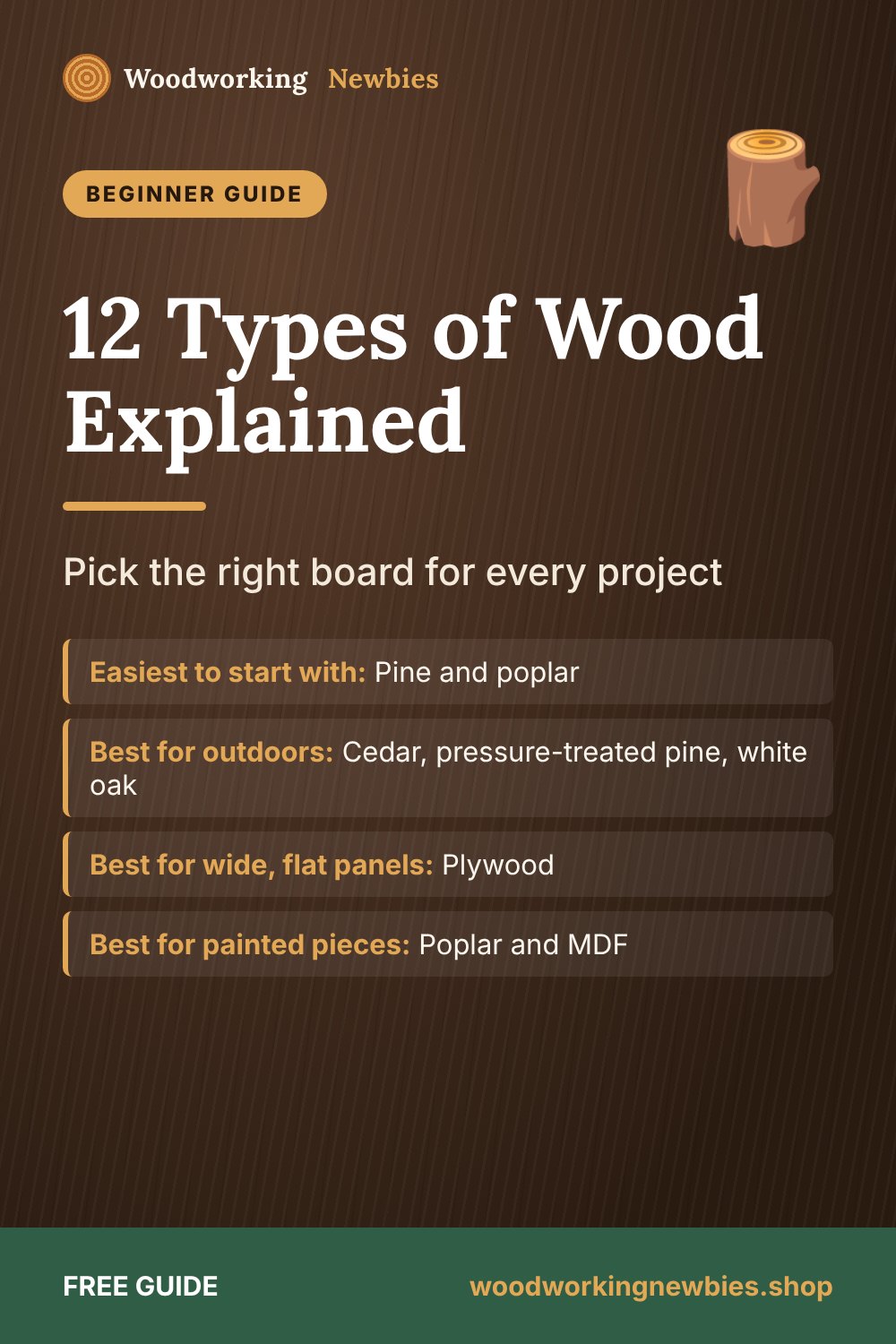
At a glance
- Easiest to start with
- Pine and poplar
- Best for outdoors
- Cedar, pressure-treated pine, white oak
- Best for wide, flat panels
- Plywood
- Best for painted pieces
- Poplar and MDF
- Hardest on tools
- Hard maple and white oak
Beginner shortcut
Not sure which wood a project needs? Every plan in the TedsWoodworking library comes with a materials list, so you know exactly which boards and how many to buy before you drive to the store.
Softwood vs hardwood: what the words really mean
The names are confusing, because they are not about how hard the wood feels. Softwoods come from conifers, the trees with needles and cones, such as pine, fir, spruce and cedar. Hardwoods come from broad-leaf trees that drop their leaves, such as oak, maple and walnut.
Most softwoods really are softer, but not all. Southern yellow pine is harder than poplar, which is technically a hardwood. Treat the labels as a family name.
A third group, sheet goods, is made in a factory from wood veneers or fibers. Plywood and MDF come in big flat sheets, usually 4 x 8 ft (about 1.2 x 2.4 m), and they solve problems solid wood cannot, such as a wide cabinet side that never cups.
Why this matters for a beginner
Picking the wrong wood is a quiet mistake. The project looks fine on day one, then a red oak planter rots in two seasons, or a pine tabletop gets dented by the first coffee mug. Matching the wood to the job saves you from rebuilding it later.
Types of wood for woodworking: comparison table
Here is the quick comparison. "Hardness" is relative, from soft (dents with a fingernail) to very hard (resists dents well). "Cost" is relative to the other boards on this list, because prices vary a lot by region and by year.
| Wood | Group | Hardness | Workability | Outdoors? | Relative cost |
|---|---|---|---|---|---|
| Pine and SPF studs | Softwood | Soft to medium | Very easy | No, unless treated | Low |
| Douglas fir | Softwood | Medium | Easy, can splinter | Covered areas only | Low to medium |
| Western red cedar | Softwood | Soft | Very easy | Yes (heartwood) | Medium |
| Pressure-treated pine | Softwood | Medium | Easy, often wet | Yes | Low |
| Poplar | Hardwood | Soft to medium | Very easy | No | Low to medium |
| Red oak | Hardwood | Hard | Moderate | No | Medium |
| White oak | Hardwood | Hard | Moderate | Yes, fairly good | Medium to high |
| Hard maple | Hardwood | Very hard | Harder, burns easily | No | Medium to high |
| Cherry | Hardwood | Medium | Easy with sharp tools | No | High |
| Black walnut | Hardwood | Medium to hard | Easy | No | High |
| Plywood | Sheet good | Depends on face veneer | Easy, edges tear out | Exterior grades only | Medium per sheet |
| MDF | Sheet good | Hard surface, weak edges | Easy, very dusty | No | Low |
The softwoods
1. Pine (and SPF studs)
Pine is the classic beginner wood. White pine (often sold as "common board" or "select pine") is light, soft and very easy to cut, drill and sand. Southern yellow pine is heavier, harder and more resinous, and it is the wood used for most pressure-treated lumber in the US.
The 2x4s in the framing aisle are usually stamped "SPF" (spruce, pine or fir). They are made for walls, not furniture, so they are often wetter and knottier, but they are great for workbenches, shop shelves and rustic projects. Pick them one at a time using our guide on how to pick straight lumber.
Watch out for: knots, sap pockets and dents. Pine also blotches when stained, so read how to stain pine without blotches before you open the can.
2. Douglas fir
Douglas fir is strong and stiff for its weight, with a straight grain and a reddish-tan color. It is widely used for framing lumber, especially in the western US and Canada.
Watch out for: splinters along the edges, and uneven color when stained, a lot like pine. Sand the edges well.
3. Western red cedar
Cedar is light, soft, smells great and is one of the easiest woods to cut. Its heartwood (the darker, reddish part) naturally resists rot and insects, which is why it is a favorite for planters, fences, outdoor benches and raised garden beds. Cedar fence pickets are a low-cost way to build small outdoor projects, like our fence picket planter box.
Watch out for: it dents and splits easily, so pre-drill near the ends. Use stainless steel or coated exterior screws, because plain steel can leave dark stains in cedar. The fine dust can irritate your nose and lungs, so wear a dust mask when sanding.
4. Pressure-treated pine
Pressure-treated (PT) lumber is usually southern yellow pine that has been forced full of a preservative to resist rot and insects. Labels say whether it is rated for "above ground" or "ground contact". Use ground-contact lumber for anything that touches soil or stays wet.
Watch out for:
- It is often sold wet. Let it dry before you paint or stain it. A drop of water that soaks in quickly is a good sign it is ready.
- Modern treatments can corrode plain steel. Use screws and hardware rated for treated lumber, such as hot-dip galvanized or stainless steel, and check the label.
- Wear gloves and a dust mask when cutting, wash your hands before eating, and never burn the offcuts.
- Keep it outdoors. It is not a choice for indoor furniture, toys or cutting boards. For vegetable beds, using PT lumber is debated, so cedar or a lined bed is the cautious choice.
Right wood, right plan
Plans that tell you what to buy
Guessing at the lumber yard wastes money and weekends. TedsWoodworking plans list the boards, sizes and quantities for each project, so you buy once and build.
- 16,000+ plans for indoor and outdoor projects
- Materials lists and cut lists with every plan
- Step-by-step diagrams for beginners
- $67 one-time, 60-day money-back guarantee
Read our honest TedsWoodworking review before you buy.
The hardwoods
5. Poplar
Poplar is the friendliest hardwood for beginners. It is fairly soft, machines cleanly, holds screws better than pine and is usually the lowest-cost hardwood at the home center. It often has green, gray or even purple streaks, which is why most people paint it.
Good for: painted furniture, trim, drawer parts, shop jigs. Watch out for: it can stain unevenly, so test first or plan to paint.
6. Red oak
Red oak is the hardwood you will see most often in big-box stores. It is hard, strong and has a bold, open grain with a slightly pink tone. It takes stain well because the open pores soak up color.
Watch out for: those same open pores let water travel deep into the wood, so red oak rots quickly outdoors. Keep it inside. Pre-drill every screw hole, because oak splits if you drive screws without a pilot.
7. White oak
White oak looks similar to red oak but is a little browner, and its pores are mostly plugged inside the wood. That makes it far more water-resistant, which is why it has long been used for boats, barrels and outdoor furniture.
Good for: tables, chairs, outdoor pieces, Mission and farmhouse styles. Watch out for: it is hard, heavy and dulls tools faster, and you may need a lumber yard to find it.
8. Hard maple
Hard maple (sugar maple) is very hard, pale and fine-grained. It shrugs off dents, which makes it a top choice for cutting boards, butcher blocks, workbench tops and kitchen items. See our guide to the best food-safe finish for cutting boards if you are making one.
Watch out for: it burns easily on a table saw or router if you feed slowly or use a dull blade, and it can blotch under stain. Most people leave maple natural.
9. Cherry
Cherry is a classic furniture wood with a fine, smooth grain. It starts out a light pinkish-tan and darkens to a deep reddish brown with exposure to light over months and years.
Watch out for: it burns easily, and stain can look blotchy. Most woodworkers let it darken naturally under a clear oil or varnish.
10. Black walnut
Walnut is the dark, chocolate-brown wood people love for coffee tables, boxes and serving boards. It works easily with hand and power tools, finishes beautifully and needs no stain at all. The outer sapwood is pale, so plan your cuts to keep it out of sight, or use it as a contrast stripe.
Watch out for: it is usually one of the higher-cost domestic hardwoods, so practice your joinery on poplar first. Some people are sensitive to walnut dust, so use dust collection and a mask.
The sheet goods
11. Plywood
Plywood is made of thin layers of wood glued with the grain of each layer turned 90 degrees to the next. That cross-grain build makes it strong, light for its size and very stable, so it does not cup or split the way a wide solid board can.
- Construction plywood (such as CDX) is rough and meant for sheathing. Fine for shop projects.
- Sanded pine or birch plywood has smoother faces for shelves, cabinets and painted furniture.
- Hardwood plywood has an oak, maple or birch face veneer, so it matches solid boards.
- Baltic birch has many thin, void-free layers. It is great for drawers, jigs and boxes with visible edges.
- Exterior plywood uses waterproof glue. Only this type belongs outside, and its edges still need sealing.
Face veneers are thin, so sand lightly and hide the edges with edge banding or solid wood strips.
12. MDF
MDF (medium-density fiberboard) is wood fiber pressed with glue into dead-flat, smooth sheets. It is low cost, perfectly stable and paints beautifully, which makes it handy for painted cabinets, signs, templates and jigs.
Watch out for: it is heavy, it sags on long shelf spans, it swells badly if it gets wet, and screws hold poorly in its edges, so pre-drill and use glue. MDF makes very fine dust, so wear a well-fitting dust mask or respirator and use dust collection.
How to choose the right wood for your project
Ask four questions, in this order:
- Will it live outside? Choose cedar, pressure-treated pine or white oak, plus exterior screws and finish.
- Will it be painted? Choose poplar, pine, MDF or sanded plywood. There is no reason to pay for figured hardwood you will cover up.
- Will it take hard wear? Tabletops, chairs and cutting boards do better in maple, oak, cherry or walnut.
- Is it wide and flat? Cabinet sides, tall bookcase sides and drawer bottoms are easier in plywood.
| Project | Good first choice | Upgrade |
|---|---|---|
| Shop shelves, workbench | SPF 2x4s and construction plywood | Sanded plywood top |
| Bookshelf (painted) | Poplar or sanded plywood | MDF shelves with solid edging |
| Bookshelf (stained) | Select pine | Oak plywood with oak edging |
| Coffee table | Pine | Oak, cherry or walnut |
| Cutting board | Hard maple | Maple with walnut or cherry stripes |
| Planter or garden bench | Cedar | White oak |
| Deck or ground-contact frame | Ground-contact pressure-treated | Cedar for visible parts |
For a deeper look at the best starter woods, see our guide to the best wood for beginner woodworking projects.
Buying tips: sizes, grades and moisture
Nominal vs actual size. A "2x4" really measures about 1-1/2 x 3-1/2 in (38 x 89 mm), and a "1x6" is about 3/4 x 5-1/2 in. Plans should give actual sizes, but always measure your own boards.
Hardwood thickness. Lumber yards sell hardwood in quarters: 4/4 is about 1 in thick rough, and around 3/4 in once planed smooth. Home centers sell it already planed, labeled with the actual size.
Grades. Higher grades mean fewer knots. "Select" or "clear" pine costs more than "common" pine. For paint-grade work, common boards with small tight knots are fine.
Moisture. Wood shrinks and swells with the seasons. Store new boards flat and indoors in your shop for a week or two before cutting, so they settle to your space. Kiln-dried lumber is best for furniture.
Common mistakes when choosing wood
- Using indoor wood outside. Pine, poplar, red oak and MDF rot or swell fast in the weather.
- Bringing pressure-treated lumber indoors. Keep it for outdoor builds only.
- Buying the first board on the pile. Check every board for twist, cup, bow, cracks and large loose knots.
- Staining blotch-prone woods without a test. Pine, fir, maple, cherry and poplar all need a test board first. Our wood staining guide for beginners explains which stain suits each.
- Skipping pilot holes in hardwood. Oak and maple split easily near ends.
- Using MDF for long shelves. It sags over time. Use plywood or add a solid wood strip under the front edge.
Match the wood to the plan
Browse thousands of indoor and outdoor projects inside TedsWoodworking, each with a materials list that tells you which boards to buy and how many.
One-time payment · Lifetime access · 60-day money-back guarantee
Save this for later
Pin this guide to your woodworking board on Pinterest so it is ready when you head to the shop.
FAQ
What is the easiest wood for a beginner to work with?
Pine and poplar. Both are soft enough to cut and sand easily, widely available, and forgiving of small mistakes. Poplar is better for painted pieces, pine for rustic or stained ones.
Which wood lasts longest outdoors?
Among common boards, cedar heartwood, white oak and ground-contact pressure-treated pine hold up best. Any of them still lasts longer with a good exterior finish and with end grain kept off wet ground.
Is plywood real wood?
Yes. Plywood is made from thin layers of real wood veneer glued together. MDF is also made from wood, but as fine fibers pressed with glue, so it has no grain.
Can I mix different woods in one project?
Yes. Many pieces use a plywood case with solid wood edging, or a pine base with an oak top. Keep the grain direction in mind so parts can move together, and test your finish on each species.


