
To start woodworking without a garage, choose a small setup that suits your home: a balcony or patio bench, a closet "shop in a cabinet", a spare-room corner, or a kitchen table you protect and pack away. Use mostly hand tools and a cordless drill, have big cuts made at the store, and pick small first projects that fit the space.
Plenty of beginners build their first projects this way. If you have not picked up a tool yet, read our pillar guide on how to start woodworking with no experience first, then come back to set up your space.
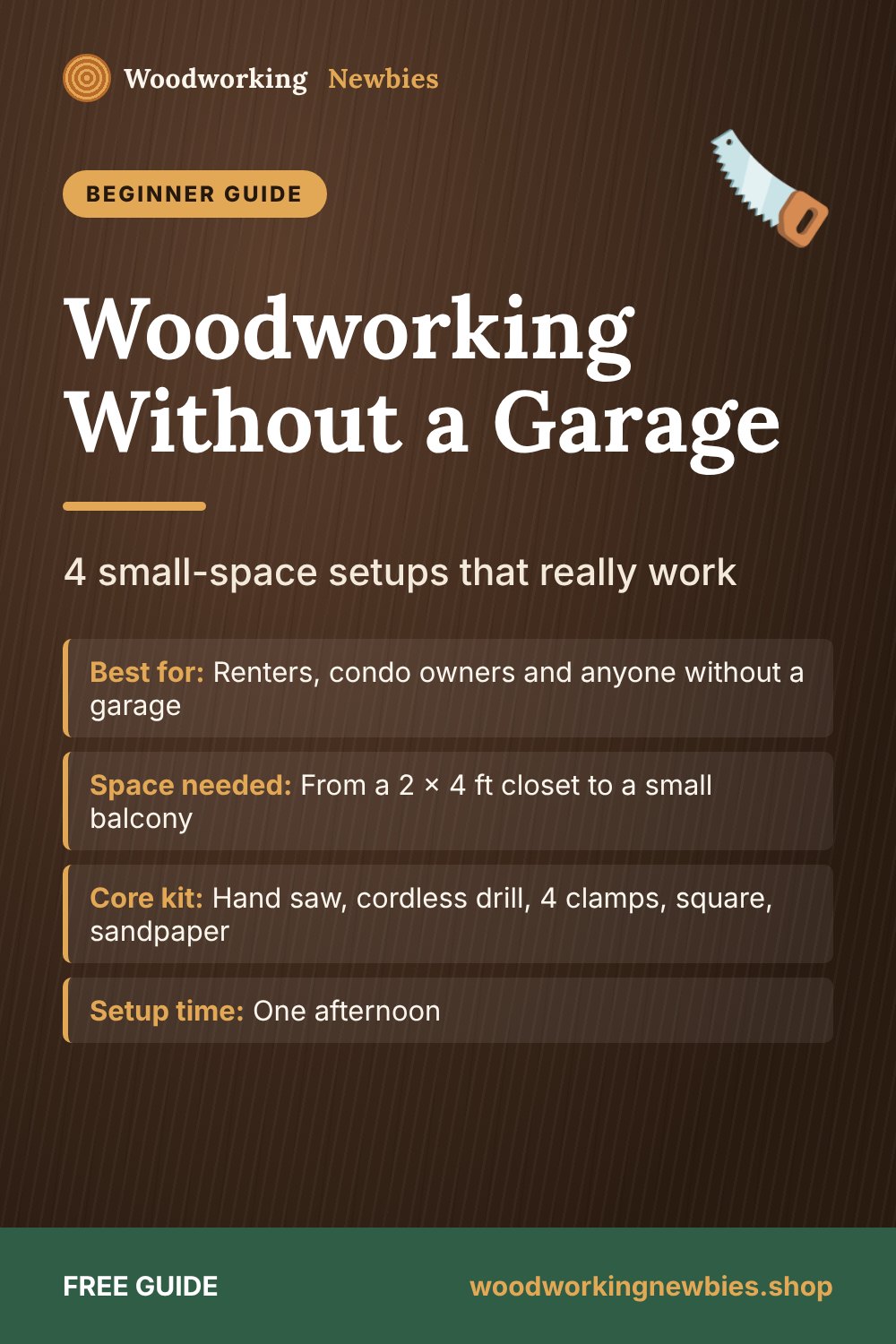
At a glance
- Best for
- Renters, condo owners and anyone without a garage
- Space needed
- From a 2 x 4 ft closet to a small balcony
- Core kit
- Hand saw, cordless drill, 4 clamps, square, sandpaper
- Setup time
- One afternoon
- Typical first build
- Box, shelf or plant stand
Beginner shortcut
Want projects that fit a tiny workspace? The TedsWoodworking plans include workshop and small-space ideas with full materials lists, so you only buy what you need.
Four setups for woodworking without a garage
Pick the one that matches your home. You can mix them, too: cut on the balcony, assemble at the kitchen table.
| Setup | Space | Good for | Main limits |
|---|---|---|---|
| Balcony or patio | Any outdoor nook with a flat floor | Sawing, sanding, finishing | Weather, building rules, neighbors below |
| Closet workshop | A closet or tall cabinet, about 2 x 4 ft | Storing tools, fold-out bench work | Small work surface |
| Spare-room corner | About 4 x 6 ft | A permanent small bench | Dust control indoors |
| Kitchen table | Shared table, packed away after | Assembly, gluing, hand-tool work | Must protect the table and clean up fully |
Setup 1: The balcony or patio shop
Outdoors is the best place for the messy steps. Dust blows away, finish fumes clear quickly, and noise doesn't echo around a small room.
- Use a folding workbench or two sawhorses with a plywood top.
- Put down an outdoor rug or rubber mat to protect the floor and catch screws.
- Bring tools inside after each session. Rain and dew rust tools fast.
- Check your building rules. Some balconies have weight limits or bans on certain activities.
- Don't let sawdust or offcuts fall onto the balcony below.
Setup 2: The closet workshop
A closet makes a neat, lockable tool store. Hang a pegboard or a French cleat panel on the back wall for hand tools. Add a fold-down bench: a plywood top hinged to a ledger on the wall, held level with folding brackets rated for the load. Close the doors and it disappears.
A closet is for storage and light work only. Do not sand or finish inside a closed closet. There is no airflow, and dust and fumes build up.
Setup 3: The spare-room corner
If you can give up a corner, a small permanent bench is a huge help. A 2x4 bench about 24 x 48 in (61 x 122 cm) is enough. Our 2x4 workbench plans can be scaled down to suit. Put it against a wall for stability, add a light above it, and lay a mat under it to catch dust.
Setup 4: The kitchen-table setup
Many beginners start right here, and it works well for assembly and hand-tool jobs.
- Cover the table with a moving blanket, then a sheet of 1/4 in plywood or hardboard on top.
- Clamp a bench hook or a scrap board to the edge to saw against.
- Keep glue, finish and food apart. Wipe down everything after.
- Pack tools into one bin so you can clear the table in five minutes.
The tools you actually need
Without a garage, you want tools that are quiet, compact and safe to use on a small surface. Our list of essential woodworking tools for beginners goes deeper, but this short kit covers most first projects.
- Hand saw (a pull saw is easiest to control) and a simple miter box
- Cordless drill/driver with a set of drill bits and driver bits
- Clamps: at least four, 12 in or longer
- Speed square or combination square, tape measure and pencil
- Sanding block and sandpaper in 80, 120 and 180 grit
- Wood glue and a box of wood screws
- Safety glasses, hearing protection and a dust mask
Small-space shop
Build your space, then build in it
Tool racks, fold-down benches and small furniture: TedsWoodworking has 16,000+ plans with cut lists and diagrams, so a cramped corner still turns out tidy projects.
- Workshop storage and fold-away bench ideas
- Materials lists so you buy only what fits
- Step-by-step diagrams for beginners
- One-time $67 with lifetime access
Not sure yet? Read our look at whether TedsWoodworking is legit.
Get the big cuts done for you
A full sheet of plywood is 48 x 96 in (about 1.2 x 2.4 m). It won't fit in a small car or a small room. Most home centers will cut sheets and boards into smaller pieces for you, though policies and fees vary, so ask first. Bring a written cut list and allow a little extra on each part so you can trim at home. Some community makerspaces also offer table saw time after a safety induction.
Safety in a small space
- Clamp the work every time. Holding a board with one hand while you saw or drill is how slips happen.
- Keep the floor clear. Offcuts and cords are trip hazards in a tight room.
- Ventilate. Sand and finish with a window open and a fan blowing out, or move outside.
- Dispose of oily rags safely. Rags with oil-based finishes can self-heat and catch fire. Lay them flat outdoors to dry or keep them in a sealed metal can with water.
- Use eye and lung protection even for hand sanding.
Good first projects for a no-garage shop
Choose projects that are small, need few long cuts and teach one new skill each.
- A bench hook. A simple sawing jig that makes every crosscut easier.
- A small tool tote. Holds your kit and teaches box-making.
- A wall shelf. Two cuts and a cleat. Practise finding studs.
- A plant stand or side table. Teaches square frames and legs.
- Wooden gifts like coasters, a phone stand or a key holder.
For more quiet ideas, see our list of woodworking projects for an apartment. If you later get a little more room, our guide to a small woodworking shop in a one-car garage shows how to lay one out.
Find projects that suit your setup
Search the TedsWoodworking library for small builds, fold-away workstations and storage you can make without a garage. Lifetime access and a 60-day refund through ClickBank.
One-time payment · Lifetime access · 60-day money-back guarantee
Save this for later
Pin this guide to your woodworking board on Pinterest so it is ready when you head to the shop.
FAQ
Can you really do woodworking without a garage?
Yes. Many beginners start on a balcony, in a spare corner or at the kitchen table. Use hand tools and a cordless drill, have long cuts made at the store, and build smaller projects.
Where should I sand and apply finish without a garage?
Outside if possible, such as a balcony or patio. Indoors, open a window, run a fan blowing out, wear a dust mask and choose a water-based finish.
How much space do I need to start woodworking?
A surface about 2 x 4 ft and room to stand around it is enough for small projects. A 4 x 6 ft corner lets you keep a small bench set up.
What is the first tool to buy without a garage?
A cordless drill/driver, followed closely by a hand saw and clamps. Together they handle most beginner projects.


