
The best easy weekend woodworking projects for beginners use common boards, straight cuts and screws or glue, so you can build on Saturday and finish on Sunday. Good picks include a cutting board, a wall shelf, a planter box, a step stool, a shoe rack and a 2x4 bench. Each one teaches a basic skill you will use on bigger builds later.
New to the hobby? Our guide on how to start woodworking with no experience covers the basics, and our list of essential woodworking tools for beginners shows what to buy first.
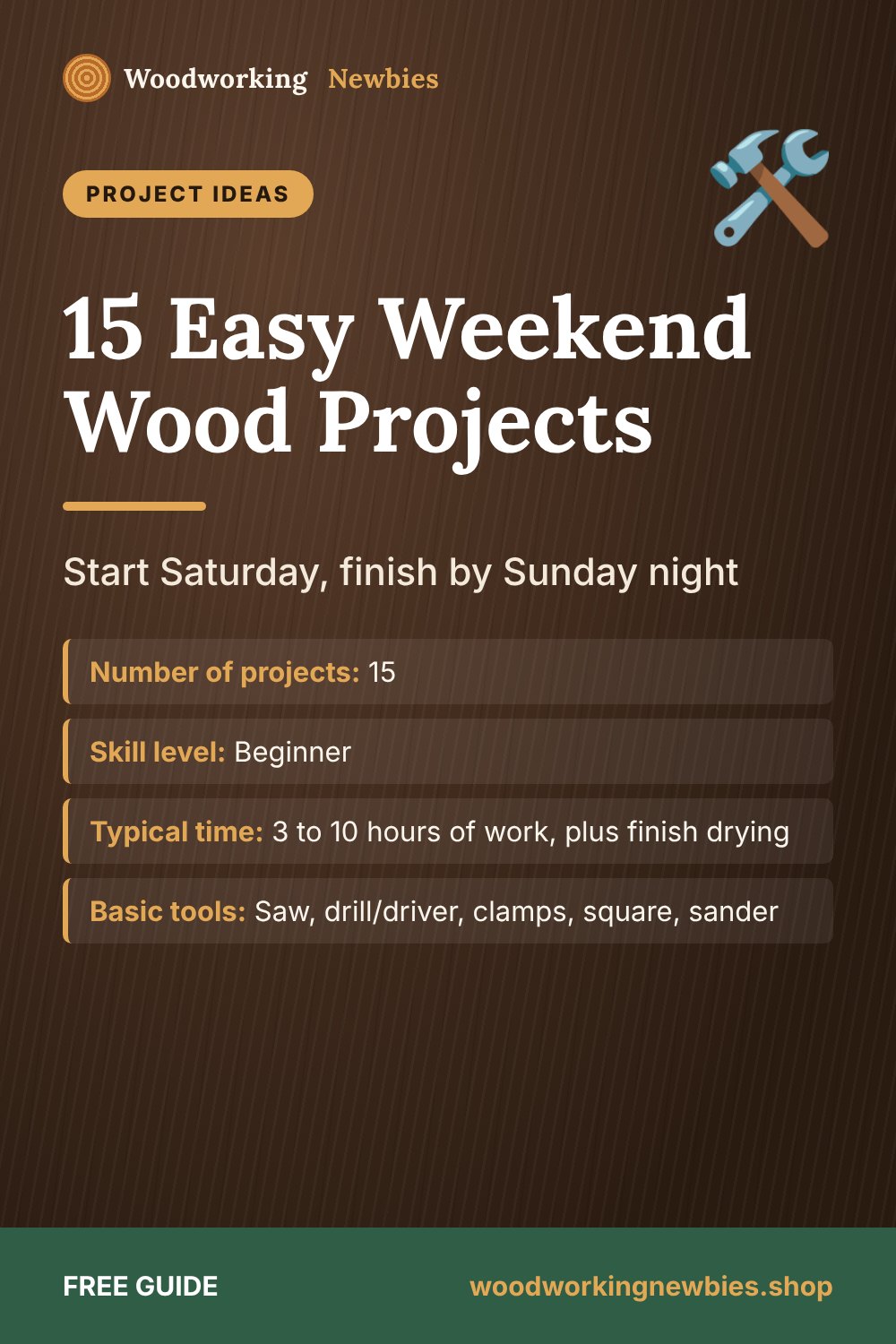
At a glance
- Number of projects
- 15
- Skill level
- Beginner
- Typical time
- 3 to 10 hours of work, plus finish drying
- Basic tools
- Saw, drill/driver, clamps, square, sander
- Common woods
- Pine, poplar, cedar and 2x4s
Beginner shortcut
Want a weekend project with every cut already worked out? The TedsWoodworking plans include cut lists and materials lists, so you can shop Friday night and start building Saturday morning.
How to plan a woodworking weekend
Most weekend projects fail because of time, not skill. Finish needs drying time, so plan backwards from Sunday evening.
| When | What to do |
|---|---|
| Friday evening | Pick the project, write a cut list, buy wood and supplies |
| Saturday morning | Cut all parts and label them |
| Saturday afternoon | Dry-fit, then glue and screw the assembly |
| Saturday evening | Sand while glue cures; fill any holes |
| Sunday | Apply finish, following the can's drying times between coats |
Tip: choose a finish with a short recoat time, like a water-based polyurethane, if you want two coats by Sunday night. Always check the label, because drying times change with temperature and humidity.
15 easy weekend woodworking projects for beginners
The projects go roughly from easiest to most involved. Pick one that fits your tools and your space.
1. Hardwood cutting board
Wood: one planed maple or cherry board. Skill: clean crosscuts, sanding and a food-safe finish. Round the corners and add a handle hole if you like. Read up on the best food-safe finish for cutting boards before you finish it.
2. Floating wall shelf
Wood: one 1x8 or 1x10 pine board. Skill: finding studs and mounting level. Our simple floating shelf plans use a hidden cleat.
3. Wooden crate or storage box
Wood: 1x4 or 1x6 pine. Skill: square corners and glue-ups. Useful in any room and a great gift.
4. Picture frame
Wood: 1x2 or 1x3 poplar. Skill: accurate 45-degree miters. Use a miter box or miter saw and a band clamp.
5. Coat hook rail
Wood: one 1x4 or 1x6. Skill: even spacing and wall mounting. Add hooks every 6 to 8 in.
6. Phone and tablet stand
Wood: offcuts of hardwood. Skill: angled cuts and careful marking.
7. Step stool
Wood: 1x10 or 1x12 pine. Skill: strong joints that carry weight. Use glue plus screws and keep the stance wide.
8. Shoe rack
Wood: 1x3 slats and 2x2 legs. Skill: repeatable spacing with a spacer block.
9. Planter box
Wood: cedar fence pickets. Skill: outdoor fasteners and drainage. See our fence picket planter box plans.
10. Birdhouse
Wood: one 1x6 cedar board. Skill: angled roof cuts. Leave the inside unfinished and add drain and vent holes.
11. Simple bookshelf
Wood: 1x10 pine boards. Skill: long cuts kept square, and anchoring furniture to the wall. Our bookshelf plans for beginners walk you through it.
12. Plant stand or side table
Wood: 2x2 legs and 1x4 aprons. Skill: building a level, square frame.
13. Raised dog bowl stand
Wood: 1x12 top and 1x4 sides. Skill: cutting holes with a jigsaw. Size it to your dog's height.
14. 2x4 outdoor bench
Wood: 2x4s only. Skill: strong screwed joints. See our simple 2x4 outdoor bench plans.
15. Small workbench
Wood: 2x4s and a plywood top. Skill: a full build from cut list to finished piece. Our 2x4 workbench plans are a classic first big project.
Weekend builds
Never run out of weekend projects
TedsWoodworking gives you 16,000+ plans, and according to the sales page most of them are beginner plans that need only a saw, a drill, clamps and a sander.
- Small gifts, furniture and outdoor builds
- Cut lists and materials lists for easy shopping
- Step-by-step diagrams for each stage
- $67 one time, 60-day money-back guarantee via ClickBank
Read our honest TedsWoodworking review before you buy.
How to choose the right weekend project
Ask yourself three questions before you pick.
- What tools do I own today? If you only have a hand saw and a drill, start with the cutting board, shelf, hook rail or box. Save the bookshelf and workbench for when you have a circular saw and a straightedge guide.
- Where will I work? In a small space, stick to projects with short parts. Long 2x4 builds need room to cut and assemble. If space is tight, see our tips for woodworking in an apartment.
- What skill do I want to learn next? Each project above lists one. Choose a project that adds a single new skill, not three at once.
Finishing one simple project is better than starting an ambitious one you can't complete. Confidence builds fast once you have a few finished pieces in the house.
Quick comparison table
| Project | Main tools | Skill it teaches | Difficulty |
|---|---|---|---|
| Cutting board | Saw, sander | Sanding, food-safe finish | Very easy |
| Floating shelf | Saw, drill, level | Wall mounting | Very easy |
| Storage box | Saw, drill, clamps | Square glue-ups | Easy |
| Picture frame | Miter box or miter saw | 45-degree miters | Easy |
| Step stool | Saw, drill, clamps | Load-bearing joints | Easy |
| Planter box | Saw, drill | Outdoor building | Easy |
| Bookshelf | Circular saw, drill | Long square cuts | Easy to moderate |
| 2x4 bench | Saw, drill | Strong screwed joints | Easy to moderate |
| Workbench | Circular saw, drill | A full build | Moderate |
Tips to actually finish by Sunday
- Write the cut list first. Cutting everything in one session saves hours. Our guide on how to read woodworking plans helps.
- Buy straight boards. A twisted board can ruin a whole afternoon.
- Dry-fit before glue. Fixing a mistake is quicker before the glue sets.
- Sand parts before assembly where you can. Flat parts are easier to sand than inside corners.
- Keep it simple. Paint or a clear coat is faster than stain plus topcoat.
- Stay safe when you're tired. Late-evening cuts are when slips happen. Save tricky cuts for the morning.
Want more ideas? Our woodworking tips for beginners collect the habits that save the most time.
Line up next weekend's project now
Search the TedsWoodworking library by project type and print the cut list before Saturday. Lifetime access, no monthly fees and a 60-day refund through ClickBank.
One-time payment · Lifetime access · 60-day money-back guarantee
Save this for later
Pin this guide to your woodworking board on Pinterest so it is ready when you head to the shop.
FAQ
What is the easiest woodworking project for a beginner?
A cutting board or a floating wall shelf. Both need only a few cuts, some sanding and a finish, and you can finish either in a weekend.
Can I really finish a project in one weekend?
Yes, if you pick a small project, buy materials on Friday and choose a fast-drying finish. Check the finish label for recoat times.
What tools do I need for weekend woodworking projects?
Most of these projects need a saw, a drill/driver, a few clamps, a square, a tape measure and sandpaper or a sander.
What wood is best for weekend projects?
Pine and poplar are affordable and easy to work indoors. Use cedar or pressure-treated lumber for outdoor projects. See our guide to the best wood for beginner projects.


